
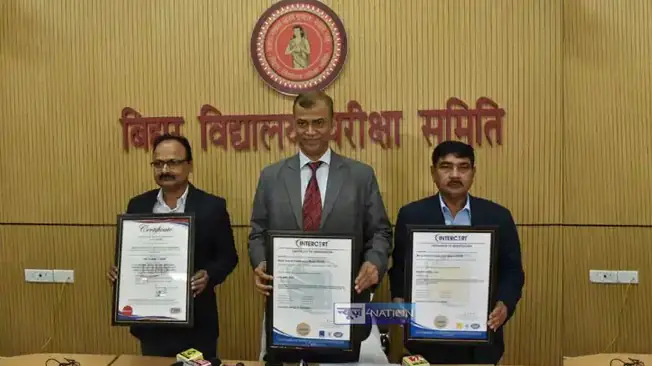
Bihar School Examination Board (BSEB) has achieved a rare national milestone by becoming the first examination board in India to receive three different international ISO certifications at the same time. These certifications recognise the board’s strong performance in quality management, information security and record management, and mark a dramatic transformation for an institution once known mainly for exam scams and irregularities.
Three international ISO certifications together
BSEB has been awarded:
- ISO 9001:2015 – for Quality Management System, which focuses on consistent processes, accountability and service quality.
- ISO/IEC 27001:2022 – for Information Security Management System, which ensures better protection of sensitive data such as student records, results and question papers.
- ISO 15489-1:2016 – for Records Management System, which sets standards for preserving, organising and accessing documents and historical records.
With these, Bihar Board has become the first examination board in the country to secure all three certifications in one go, while even larger boards like CBSE reportedly hold only two of these standards so far. This highlights how far BSEB has moved in terms of structured, audited and internationally benchmarked processes.
From controversy to model exam board
For many years, the Bihar Board was associated with controversies such as topper scams, cheating incidents and questions over the fairness of examinations. Over the last several years, however, the board has undertaken a systematic reform of its functioning. The focus has shifted to transparent procedures, strong technological integration and close monitoring at every stage of the exam cycle.
Because of these reforms, BSEB is now often presented as a model for other state boards. Officials from various states visit Bihar to study its exam system, digital workflows and monitoring mechanisms so that they can adopt similar practices in their own examination bodies. This shift from being a symbol of problems to becoming an example of good practice is one of the most important parts of this story.
Technology-led changes in the exam system
A major reason behind the ISO success is the board’s aggressive use of information technology, customised software and automation. The entire process, from registration to result declaration, has been redesigned around IT systems. Online registration, digital fee payment, e-admit cards, computer-supported evaluation workflows and automatic result preparation have significantly reduced manual intervention and human error.
Not just exams, even procedures like school recognition, affiliation and internal office movement have been brought onto digital platforms. This has improved transparency, created clear records of who did what and when, and helped the board demonstrate compliance with international quality and security standards during the ISO audit process.
Fastest result declaration and digital records
Since 2019, Bihar Board has consistently been the first in India to publish the results of its matric (Class 10) and intermediate (Class 12) examinations each year. The speed is backed by better planning, pre-exam data preparation, digitised answer-sheet handling and software-supported result processing.
Another key achievement is the complete digitisation of records from 1983 to 2025 for both matric and intermediate examinations. Decades of old documents, mark-sheets and related data have been converted into digital form. This makes it easier to verify certificates online, support students applying for jobs or higher studies and protect records from physical damage or loss.
E-office, ERP and modern data centre
Internally, BSEB has implemented an e-office system and an Enterprise Resource Planning (ERP) platform. Instead of file movements on paper, most approvals, notes and decisions now move electronically. This reduces delays, increases accountability and creates an automatic digital trail of decisions.
To support these operations, the board has set up a modern data centre with large storage capacity (running into hundreds of terabytes). This facility stores exam data, student records and applications securely, and is designed to meet demanding standards of information security and backup – a key requirement for ISO/IEC 27001.
Student services through OFSS and online systems
For students, one of the most visible changes is the Online Facilitation System for Students (OFSS). Through this portal, the board has managed applications for admission and other services for crores of students over the past several years. Instead of long queues and heavy paperwork, students can apply, track status and receive information online.
Combined with online exam forms, e-admit cards and digital result publication, this ecosystem has simplified the entire journey for students and schools. It has also helped the board maintain clean, searchable records, which supports its ISO certification under the records management standard.
Why this achievement matters
The triple ISO certification is not just a trophy; it sends a strong signal about reliability. For students and parents, it means:
- A more transparent and predictable exam system.
- Better protection of personal and academic data.
- Easier verification of results and certificates in the future.
For employers, universities and institutions in India and abroad, it indicates that the Bihar Board’s processes follow audited international norms, improving confidence in its mark-sheets and certificates. For other state boards, BSEB’s journey shows that even a deeply criticised system can be rebuilt through long-term commitment to technology, process discipline and transparency.
In short, Bihar School Examination Board’s three ISO certifications reflect a complete image makeover—from a board once known for irregularities to a national benchmark for modern, tech-driven, accountable examination systems.